
Most teams don't need another AI tool. They need someone to draw the map between what the tools can actually do and what the work actually requires.
That's what I do.
I spent 2024 at King Fahd University of Petroleum and Minerals, marking 210 academic reports per cycle. Standard AI tools couldn't hold the criteria well enough to be useful. So I built a document review pipeline in two days that matched expert human reviewers at 96% agreement and collapsed feedback time from forty minutes per document to fifteen seconds.
The pipeline now runs as a live SaaS. But building it taught me something more valuable than the product: the gap between people who use AI and people who know how to commission work from it.
Microsoft tracked 300,000 Copilot users and found the pattern most organisations know from the inside. Licenses get bought. Training gets delivered. People are excited for three weeks, then quietly revert. The tools were never the problem. The missing layer was judgement, knowing which tasks to hand over, how to verify the output, and when to override it.
I've spent three years building that layer into organisations.
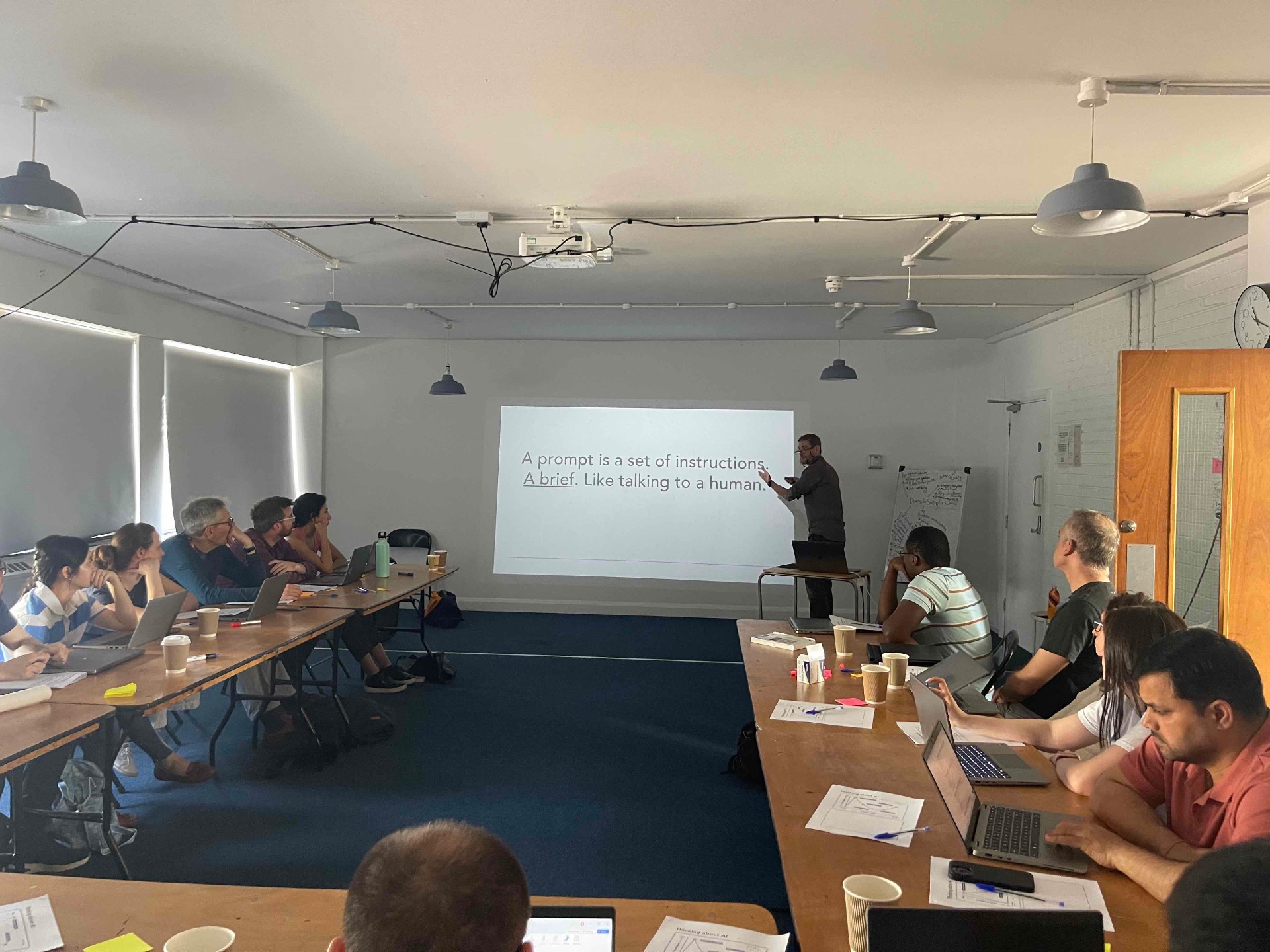
I work with UK firms through two engagements: a single-session AI Business MOT that maps where AI fits and where it doesn't, and a two-week Diagnostic Audit that turns the map into a working plan leadership can act on.
Both produce written deliverables. No lock-in to training packages. No pressure toward a build engagement. If the honest recommendation is that a firm needs time rather than tools, that's the recommendation.
The method sits on the AIMED framework and on six core judgement skills I teach at the 201 level. The 301 layer is the discipline of governing systems that act on your behalf. All three live on this site.
The shape of my work comes from four layers that most AI consultants don't hold together.
Chemistry first. B.Sc Hons in Organic Chemistry from the University of Adelaide. Trained me to think in systems, reactions, and rigorous evidence.
Then a decade inside Saudi Aramco delivering technical training to engineers. That's where I learned how to specify work to audiences who won't forgive vagueness.
Then English teaching. Years of it. Eliciting precise answers from students translates directly into eliciting precise output from models. The skill of shaping a question until it produces what the work actually needs is the same skill.
Then a data science qualification from Columbia. Gave me the algorithmic frame for the systems I now build.
The compound effect is that I can sit with your engineers and talk architecture, then walk into your boardroom and talk governance for agentic systems, in language that lands with both rooms.
Dual national, Australian-British, based in the UK. Fluent conversational Arabic, built over fifteen years in the Gulf, where I've taught engineers and faculty on the ground.